Tourist visa or E-class ordinary visa? EB, ER, or ES extension? FPCS registration? Tourist visa or E-class ordinary visa — the choice most people get wrong. Lord Penh explains Cambodia's visa system for people who are actually staying.
The standard option for anyone visiting Cambodia for a holiday or short trip. Valid for 30 days from entry, extendable once for another 30 days. Maximum stay on this route: around 60 days.
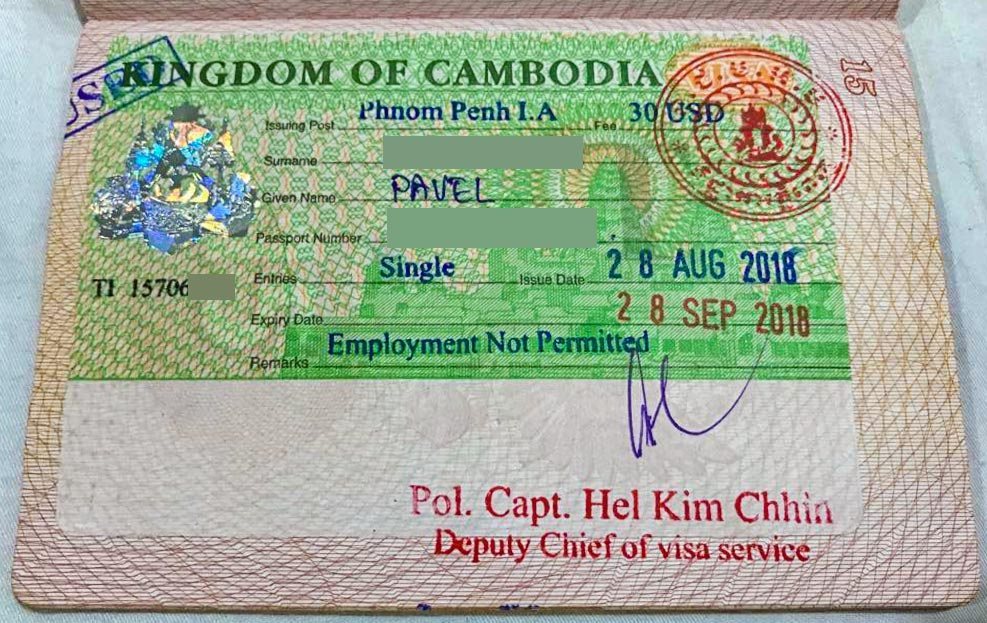
Available as an e-visa (applied online before travel, approval sent by email) or on arrival at major entry points. Under Cambodia's digital entry system, visa on arrival no longer always means a sticker in your passport — the record may be entirely electronic. That is not an error.
The foundation of every meaningful long-term stay in Cambodia. Issued for a short period on arrival, but unlike the tourist visa it can be extended into several categories — for workers, retirees, students, and business operators — giving stays of 3, 6, or 12 months at a time.
If you are moving to Phnom Penh, working remotely, running a business, or retiring here, this is your visa. Starting with a tourist visa to "see how it goes" creates unnecessary complications later and does not reliably convert to an E-class after entry.
Passport validity: Your passport must be valid for at least six months on the date of entry into Cambodia. This is a hard requirement, not a guideline.
For foreigners working in Cambodia, running a business, or operating as a freelancer with supporting documentation. The most common long-stay extension.
For those actively looking for employment in Cambodia. Shorter duration than EB, intended as a bridge while arranging work.
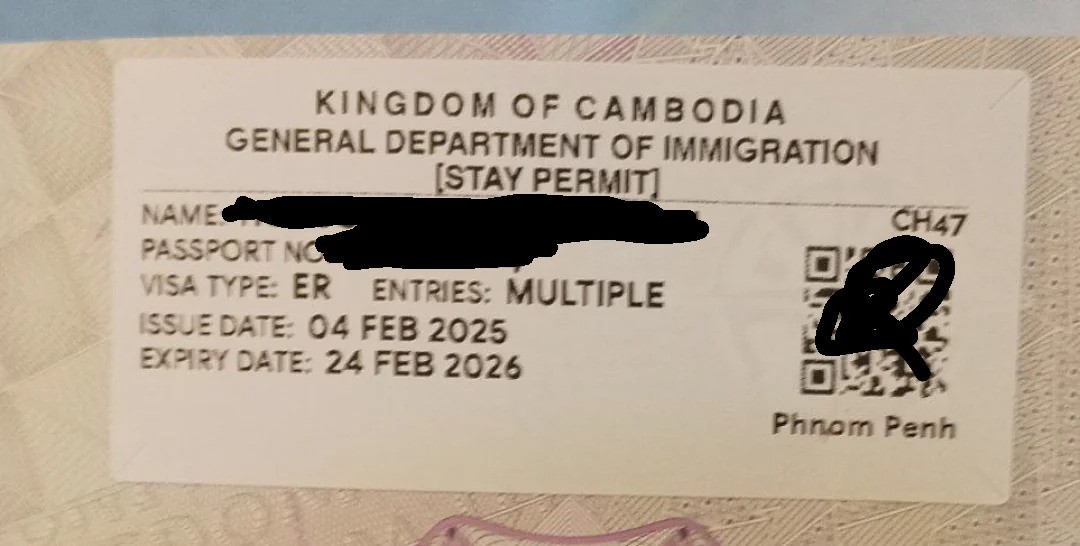
For retirees aged 55 or older who are not employed in Cambodia. Applied for inside the country after entering on an E-class visa. Renewable indefinitely. See the full section below.
For those enrolled in a recognized educational institution in Cambodia. Requires proof of enrollment from the institution.
On freelancers and digital nomads: Cambodia has no dedicated digital nomad visa, despite what older blog posts suggest. Freelancers may technically fall under the EB category, but longer renewals increasingly require documented proof of business activity or employment. The system has tightened. Approach this route with paperwork, not optimism.
You cannot apply for a retirement visa from outside Cambodia. The process is always two steps: enter on an E-class ordinary visa (not a tourist visa), then apply for the ER extension from inside the country — either directly at the Department of Immigration opposite Phnom Penh International Airport, or through a local visa agent.
Most expats use an agent. Going directly to Immigration means strict documentation requirements: notarised pension proof, official translations, the full paperwork stack. Agents have established processing channels where, in many cases, a valid passport, a few photos, and the fee are sufficient — the financial documentation requirements are significantly relaxed.
| Duration | Entry | Est. cost |
|---|---|---|
| 1 or 3 months | Single-entry. Visa cancelled if you leave Cambodia. | $50–90 |
| 6 months | Multiple-entry. Leave and re-enter freely. | ~$160 |
| 12 months | Multiple-entry. Renewable indefinitely — no requirement to leave Cambodia to refresh it. | ~$290 |
What you can do with a 12-month ER visa: open local bank accounts, sign long-term residential leases, and register a vehicle in your own name. You can legally purchase condominiums and apartments under Strata Title law (from the first floor up). You cannot own land — that restriction applies to all foreigners regardless of visa type.
Health insurance: Cambodia does not legally require health insurance for the ER visa, but serious medical care in Cambodia is limited. Most retirees carry private expat insurance covering medical evacuation to Bangkok or Singapore. Budget for it.
The CM2H program is Cambodia's formal investment residency scheme, launched by the Ministry of Interior to compete with Thailand's Elite Visa and Malaysia's MM2H. It is the only pathway in the region that leads directly to a second passport — without giving up your existing one.
A 10-year, multiple-entry golden visa sticker in your passport. You are not required to actually live in Cambodia to maintain it — the CM2H can be held purely as a backup residency or as insurance diversification. After five years, you become legally eligible to apply for Cambodian citizenship. Cambodia permits dual nationality, so your existing passport is unaffected.
The CM2H is a formal investment immigration program, not a standard visa extension. You must fulfil one of two paths.
All applications are handled under the supervision of the General Department of Immigration through officially sanctioned legal firms.
Submit background documents to the Ministry of Interior: valid passport, clean criminal record from your home country, and proof of legitimate source of funds.
Once pre-approved, choose an eligible project. Sign the Sale and Purchase Agreement for the property and transfer the investment and processing fees.
Authorised legal agents submit official documents and property titles to the Ministry of Interior to generate your CM2H member profile.
On final approval, travel to Cambodia if outside the country. The General Department of Immigration prints and stamps the 10-year golden visa into your passport.
Use only authorised agents. Because the CM2H involves significant capital, the Cambodian government only permits applications through officially sanctioned legal firms and the Khmer Home Charity Association. The casual street-side agents who handle tourist visa renewals have no role here. If someone at a bike-rental shop offers to arrange a Golden Visa, walk away.
Hotels handle FPCS registration automatically when you check in — which is one reason short stays in hotels rarely produce bureaucratic surprises. Private rentals, serviced apartments, Airbnb-style arrangements, and informal guesthouses are far less consistent. If you are renting privately in Phnom Penh or anywhere else in Cambodia, it is worth confirming explicitly that your landlord has actually registered your presence.
This is not a bureaucratic nicety. Failure to be registered in FPCS can prevent you from extending your visa. It is the kind of small, easily overlooked detail that becomes a significant problem at exactly the wrong moment — usually when you are already at a visa office with a deadline approaching.
If you move accommodation, the registration needs to follow. It does not transfer automatically.
In short: Confirm your accommodation is registered. Do it at the beginning of your stay, not when you are trying to extend your visa.
A tourist visa works for tourism. It is not a clever workaround for a long-term stay just because it requires less documentation on day one. It caps your stay at around 60 days and leaves you in a weaker position if your plans change. If there is any realistic chance you will be in Cambodia for more than two months, start with the E-class.
This is not the official or standard process. There are visa agents in Cambodia who will tell you otherwise. Some are competent; some are optimistic; some are neither. Converting a T-class to an E-class after arrival is not a reliable pathway, and treating it as one wastes both time and money. Choose correctly at the border.
If your accommodation has not registered your presence in the FPCS database, your visa extension application may fail. This applies even if your visa itself is in perfect order. Foreigners staying in private rentals are most exposed to this problem. Verify it early.
Tourist visa (T-class): 30 days, one extension, maximum around 60 days. Good for holidays and short visits. Apply via evisa.gov.kh or on arrival.
Ordinary visa (E-class): The foundation of every long-term stay. Request it on arrival. Extendable into four categories: EB (work/business), ER (retirement), ES (student), EG (job-seeker).
Retirement visa (ER extension): Age 55+, not employed in Cambodia, applied for inside the country after entering on an E-class. The 12-month multiple-entry version is renewable indefinitely. Most expats process it through a local agent.
FPCS registration: Make sure your accommodation has registered you. This is a hard requirement for any visa extension. Do not assume it has happened.
Visa agents: Cambodia has capable agents who handle extensions on your behalf. Use one with a track record, keep your own copies of everything, and do not rely on verbal assurances about what is and is not possible.
The tourist visa (T-class) is valid for 30 days on entry and can be extended once for another 30 days — giving a maximum stay of around 60 days. The ordinary visa (E-class) is designed for longer stays and can be extended for 3, 6, or 12 months under four categories: EB for work or business, ER for retirement, ES for students, and EG for those seeking employment.
This is not the standard or official pathway. Some agents in Phnom Penh claim it can be arranged, but it is not a reliable route and frequently results in wasted time and money. If you plan to stay longer than two months, request the E-class ordinary visa at the border — not the tourist visa.
FPCS — the Foreigners Presence in Cambodia System — is the government database that records where foreign nationals are staying. Hotels register guests automatically at check-in. Private rentals and informal accommodation often do not. If your accommodation has not registered your presence, you may be unable to extend your visa even if all your other documents are in order. Confirm it at the start of your stay, not when you are already at the immigration office.
No. Cambodia does not offer a dedicated digital nomad visa. Freelancers can apply for an EB extension under the E-class ordinary visa, but renewals increasingly require documented proof of business activity or employment. The process has tightened considerably compared to what older expat guides suggest.
Not always. Under Cambodia's newer digital entry system, visa on arrival may be processed electronically without a sticker in your passport. A digital record or email confirmation serves as proof of entry. The absence of a physical stamp does not mean something has gone wrong — provided the visa was properly processed and the electronic record exists.
The Cambodia My Second Home (CM2H) program is the country's formal investment residency scheme. It offers a 10-year renewable multiple-entry visa, no minimum stay requirement, and a legal pathway to Cambodian dual citizenship after five years — without surrendering your existing passport. The main route requires a minimum $100,000 investment in approved real estate plus around $50,000 in processing fees. A direct citizenship-by-investment route is also available from approximately $250,000. This is for investors and high-net-worth individuals; it is not a standard expat or retirement visa.
You cannot apply for a Cambodia retirement visa from abroad. You must first enter Cambodia on an E-class ordinary visa, then apply for the ER (retirement) extension from inside the country — either directly at the Department of Immigration in Phnom Penh, or through a local visa agent. You must be 55 or older and not employed in Cambodia. The 12-month ER extension is multiple-entry and can be renewed indefinitely without leaving the country.